
Dairy Payment Management: The Complete Guide for Subscription Delivery Businesses
Ask any dairy operator what keeps them up at night and the answer is rarely routes or deliveries. It’s payments.
Which customers owe money. Which wallets are running low. Who hasn’t paid in three weeks. Which driver collected cash this morning but hasn’t reconciled yet. Whether the month-end numbers match.
Payment management in a subscription dairy business is deceptively complex — and when it breaks down, it creates cash flow problems, customer friction, and hours of manual admin every week.
This guide breaks down everything you need to know about dairy payment management — what it involves, where most businesses go wrong, and how the right software can put your billing and collections on autopilot.
What Is Dairy Payment Management?
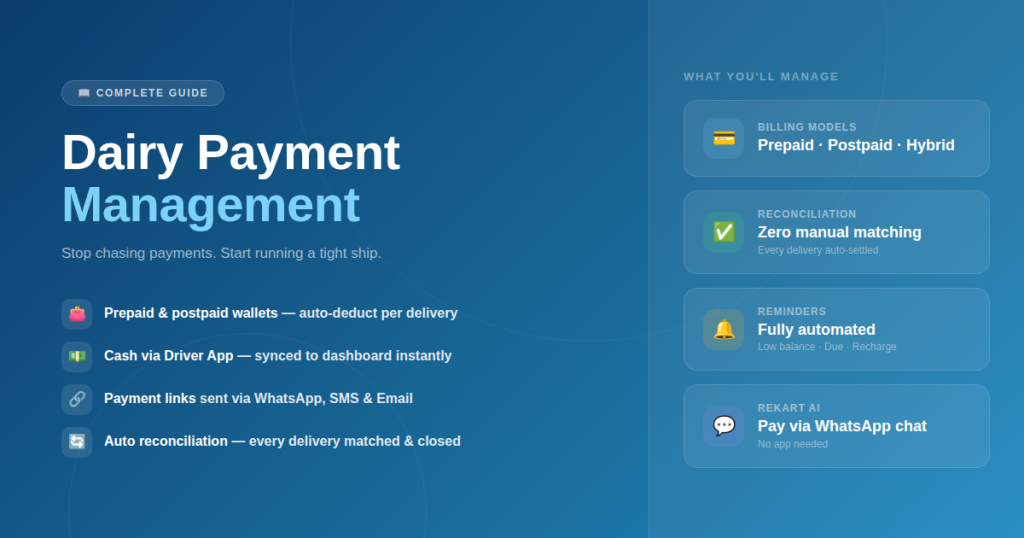
Dairy payment management refers to the end-to-end process of collecting, tracking, and reconciling payments from customers in a subscription-based dairy or milk delivery business. It covers subscription billing cycles, prepaid wallet management, cash collection from drivers, payment reminders, invoice generation, outstanding balance tracking, and payment reconciliation — all of which ideally run automatically through a single platform.
Why Dairy Payment Management Is More Complex Than It Looks
A standard e-commerce business collects payment once, at checkout. A dairy business collects payment continuously — from hundreds of customers, across multiple billing models, with daily delivery activity affecting balances every single day.
Here’s what makes it uniquely complicated:
- Multiple billing models running simultaneously: Some customers are on prepaid plans, others on postpaid. Some pay monthly, others by the litre. Managing these under one system — without errors — is non-trivial.
- Daily order changes affecting payment: A customer pausing for a week means their wallet shouldn’t be debited for those days. A quantity change mid-month needs to adjust their outstanding balance. Every delivery event has a payment implication.
- Cash still dominates in many markets: Drivers collect cash at the doorstep. That cash needs to be logged, reconciled, and matched against customer accounts — often across dozens of routes simultaneously.
- Chasing payments is time-consuming: Reminders, follow-ups, WhatsApp messages, phone calls — without automation, payment collection becomes a part-time job for the dairy owner or admin staff.
- Outstanding balances compound: A customer who owes for three weeks isn’t just a payment problem — they’re a churn risk. Without visibility into aging balances, problems are often caught too late.
The Four Core Components of Dairy Payment Management
1. Subscription Billing Models
The foundation of dairy billing software is flexibility. Different customers have different preferences, and your platform needs to handle all of them cleanly:
- Prepaid subscriptions: Customers load a wallet in advance. Each delivery deducts from the balance. Low balance triggers an automatic top-up reminder.
- Postpaid / credit billing: Deliveries are made and billed at the end of the period. The platform tracks outstanding amounts and generates statements automatically.
- Hybrid models: Some customers prefer a mix — a prepaid wallet with a credit buffer for overruns. Good dairy management software handles this without manual intervention.
Rekart supports all three models natively, including litre-based, quota-based, and prepaid/postpaid subscription types, with the ability to set credit limits and minimum commitments per customer.
2. Payment Collection Channels
Customers pay in different ways. Your payment system needs to meet them where they are:
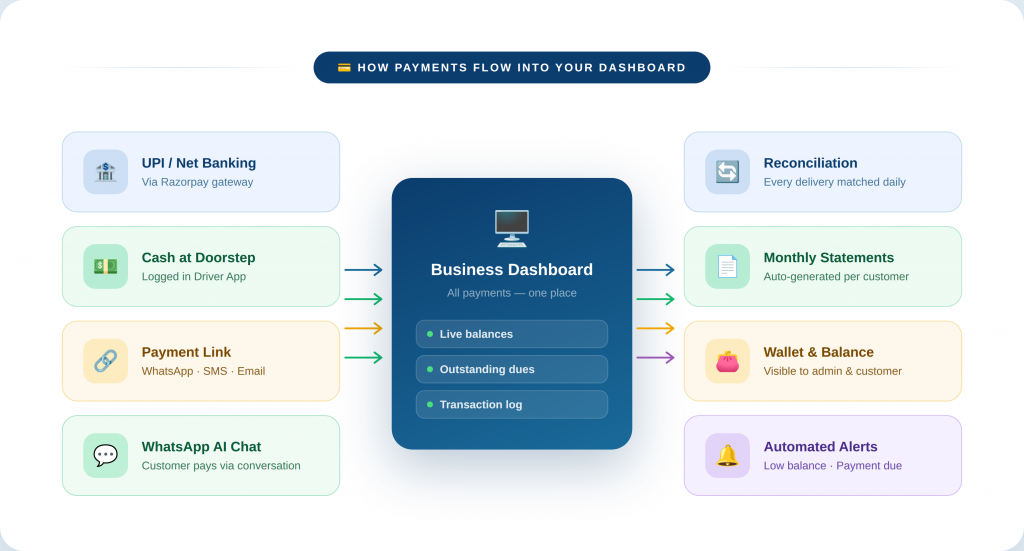
- Digital payments: UPI, net banking, and payment gateway options (Rekart integrates with Razorpay) make it easy for customers to pay online without friction.
- Built-in wallet: Customers recharge their wallet directly in the app. Balances are tracked in real time and deducted automatically per delivery.
- Cash collection: Drivers can collect and record cash payments directly in the Driver App, which syncs immediately to the business dashboard. No paper, no end-of-day confusion.
- Payment links: Unique payment links generated per customer can be shared via SMS, Email, or WhatsApp — letting customers pay instantly without logging into the app. Rekart also supports public bill links that require no login at all.
3. Automated Payment Reminders
Manual payment chasing is one of the biggest time drains in a dairy business. The fix is automated payment reminders that go out at the right moment — without anyone having to remember to send them.
What good reminder automation looks like:
- Low wallet balance alert — triggered when a customer’s wallet drops below a threshold
- Payment due reminder — sent before a postpaid bill is overdue
- Outstanding balance nudge — for customers with aging unpaid dues
- Recharge confirmation — instantly sent when a payment is received
Rekart handles all of these automatically through smart notifications — via push notifications in the customer app. No manual follow-up required.
4. Reconciliation & Reporting
At the end of the day, week, or month, your books need to balance. Dairy payment reconciliation means matching every delivery against its payment — across wallets, cash collections, digital payments, and credit accounts.
What a solid reconciliation setup gives you:
- Real-time outstanding balance visibility per customer
- Cash collection summaries per driver, per route, per day
- Monthly auto-generated statements sent to customers
- Transaction history — every credit, debit, and payment logged with timestamps
- Invoice and receipt download — available to both the business and the customer
The Real Cost of Managing Payments Manually
Many dairy businesses still manage payments through a patchwork of WhatsApp groups, handwritten ledgers, and spreadsheets. It works — until it doesn’t.
| Pain Point | What It Costs You | Software Fix |
| Manual payment reminders | 1–2 hrs/day of admin time | Automated alerts via app & notifications |
| Cash collection errors | Revenue leakage, disputes with drivers | In-app cash logging, real-time dashboard sync |
| No visibility on outstanding dues | Customers accumulate debt unnoticed | Credit limits, aging balance tracking |
| Month-end reconciliation chaos | Accounting errors, delayed closings | Auto-generated statements & transaction logs |
| Customers calling to check balance | Support overload | Self-serve wallet view in customer app |
| Payment links sent manually | Inconsistent follow-up, missed collections | Auto-generated unique links per customer |
How Rekart AI Simplifies Payment Collection on WhatsApp
One of the most common friction points in milk delivery payment software is the gap between when a customer wants to pay and when they actually do. They see the notification, intend to act, then forget.
Rekart AI — the industry’s first WhatsApp-native chatbot built into a dairy management platform — closes that gap entirely.
| 💬 Rekart AI Payment Interactions — Example Scenario: Customer: “How much is left in my wallet?” Rekart AI: “Your current wallet balance is ₹180. You have approximately 6 days of deliveries remaining. Would you like a recharge link?” Customer: “Yes, send me the link” Rekart AI: “Here’s your payment link: [link]. It’s valid for 24 hours.” Customer: “I paid cash to the driver yesterday, has it been updated?” Rekart AI: “Yes! ₹500 cash payment was recorded on your account on [date]. Your current balance is ₹500.” |
Because Rekart AI is natively integrated with the platform, every interaction — balance check, payment link request, cash confirmation — syncs instantly with your business dashboard. No manual updates, no back-and-forth between systems.
Learn more about Rekart AI and how it works.
Key Features to Look for in Dairy Payment Management Software
Not all dairy billing software handles payments with the same depth. Here’s what to evaluate:
| Payment Lifecycle Stage | What Breaks Without Software | How Rekart Handles It |
| Customer onboarding & billing setup | Billing model assigned inconsistently; credit limits never set | Configure prepaid, postpaid, or hybrid per customer at setup; credit limits enforced from day one |
| Daily delivery & wallet deduction | Admin manually adjusts balances; errors accumulate over time | Wallet auto-deducts per delivery; paused days are skipped automatically — zero manual input |
| Cash collection at doorstep | Driver keeps handwritten notes; reconciliation done at end of day with errors | Driver logs cash in-app at point of collection; syncs to dashboard instantly |
| Low balance or payment due alert | Owner or admin manually messages customers; inconsistent follow-up | Automated push notification triggered by balance threshold — no human needed |
| Customer wants to pay | Customer has to log into app or call support for a payment link | Unique payment link auto-generated per customer; shareable via WhatsApp, SMS or Email. Public bill link needs no login |
| Outstanding balance review | Spreadsheet review once a week — slow, error-prone, delayed action | Real-time outstanding balance dashboard; aging view per customer available on demand |
| Month-end reconciliation | Owner spends hours matching cash, digital, and wallet entries | Auto-generated monthly statements per customer; transaction log with timestamps for every entry |
| Customer queries their balance | Customer calls or messages support — staff time wasted | Customer checks wallet in app; or asks Rekart AI on WhatsApp and gets instant answer |
Prepaid vs Postpaid: Which Model Works Better for Dairy Businesses?
This is one of the most common decisions dairy operators face when setting up their billing. The honest answer: both work, but for different customer profiles and business contexts.
Prepaid (Wallet-Based)
- Better cash flow — money in hand before delivery happens
- Eliminates outstanding balance risk
- Customers are more price-conscious and engaged with their usage
- Works well for high-frequency daily delivery customers
- Downside: Requires more customer effort upfront; some customers resist top-ups
Postpaid (Credit Billing)
- Lower friction for customers — pay at end of month like a utility
- Works well for corporate accounts, offices, and institutional clients
- Easier customer acquisition for price-sensitive markets
- Downside: Outstanding balance risk; requires active reconciliation and reminder workflows
Rekart supports both — and hybrid models — giving you the flexibility to assign different billing types to different customer segments. You can also set credit limits on postpaid accounts to cap exposure before it becomes a problem.
How to Set Up Payment Management for Your Dairy Business
If you’re moving from manual payment tracking to a software-based system, here’s a practical path:
Step 1: Define Your Billing Models
Decide which customers will be on prepaid wallets and which on postpaid credit. Set credit limits for postpaid accounts from day one — don’t leave it open-ended.
Step 2: Set Up Payment Channels
Configure your payment gateway (Rekart integrates with Razorpay), enable wallet recharges, and activate payment link generation. Make sure your drivers know how to log cash collections in the Driver App.
Step 3: Configure Automated Reminders
Set your low-balance threshold (e.g., trigger a reminder when wallet drops below 7 days of delivery value). Configure payment due reminders for postpaid accounts. This alone eliminates most of the manual follow-up.
Step 4: Establish Reconciliation Cadence
Decide how often you’ll review outstanding balances — daily for cash collections, weekly for wallet accounts, monthly for full statement reconciliation. Rekart’s dashboard gives you all of this in real time without running manual reports.
Step 5: Enable Customer Self-Serve
Turn on the customer app so subscribers can check their own balance, download invoices, and make payments without contacting support. Enable Rekart AI on WhatsApp so even less app-savvy customers can interact with their account conversationally.
Why Rekart Is Built for Dairy Payment Management
Rekart is designed specifically for subscription-based delivery businesses — which means dairy payment management isn’t an add-on feature, it’s a core part of the platform.
Here’s what operators get out of the box:
- Prepaid & postpaid billing: Both models supported natively, with hybrid options and credit limit controls
- Built-in wallet: Auto-deduction per delivery, recharge via multiple channels, low-balance alerts
- Multiple payment modes: Razorpay, UPI, net banking, cash — all tracked centrally
- Per-customer payment links: Shareable via SMS, Email, or WhatsApp; public bill links require no login
- Driver cash collection: Logged in-app, synced to dashboard in real time
- Automated reminders: Low wallet, payment due, recharge confirmation — all handled without manual effort
- Monthly statements & invoices: Auto-generated, downloadable by both admin and customer
- Rekart AI: Customers check balances, request payment links, and confirm cash payments via WhatsApp
Payments on Autopilot?
- Prepaid wallets, postpaid billing & hybrid models
- Automated reminders — low balance, payment due, recharge confirmation
- Cash collection via Driver App, synced to dashboard in real time
- Rekart AI — payment management via WhatsApp
