
How to Start a Water Jar Delivery Business in India: The Complete Operational Guide
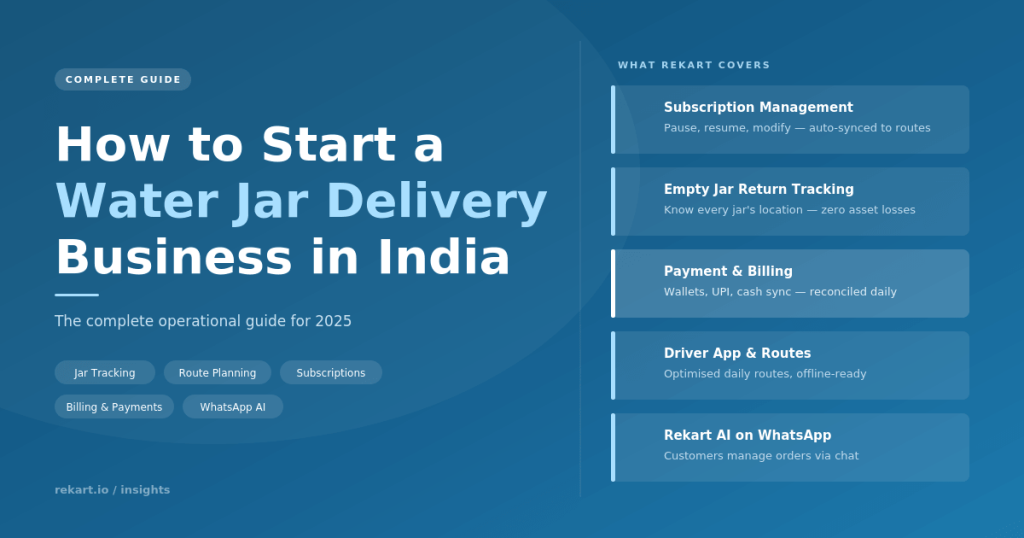
| Starting a water jar delivery business in India involves setting up a subscription-based doorstep delivery operation for 20-litre water jars — either sourcing from an existing water plant or tying up with a local supplier. The key operational elements are: a defined delivery area, a customer subscription system, optimised daily routes, jar return tracking, and a payment collection process. Modern water jar delivery businesses use dedicated delivery management software to automate all of these — reducing daily manual effort from hours to minutes. |
Why Start a Water Jar Delivery Business in India?
India’s packaged drinking water market is expected to reach USD 6.5 billion by 2032, growing at 8.8% annually — driven by rapid urbanisation, declining trust in municipal water quality, and rising health consciousness among middle-class households. In most Indian cities, municipal tap water is not considered safe to drink without additional treatment. This creates a permanent, recurring demand for clean doorstep-delivered drinking water.
The 20-litre jar delivery model sits at the most attractive intersection of this demand: high purchase frequency (weekly or bi-weekly per household), low price sensitivity (customers prioritise reliability over cost), strong retention (once a household is subscribed, churn is low), and an asset-light operation that can be started with modest capital.
Unlike a packaged water manufacturing plant — which requires crores in machinery, BIS certification, FSSAI licensing, and production infrastructure — a water jar delivery business can be started with a vehicle, a supplier tie-up, and the right software. This guide focuses entirely on the delivery and distribution side of the business.
The 20-litre jar delivery business is one of the few models in India where your customers need you every week, your product is non-negotiable, and your cost of switching to a competitor is high. Once you build the habit, you keep the customer.
Step 1: Validate Your Market and Define Your Area
Before investing in anything, spend two to three weeks doing ground-level market validation in your target area. This is the step most first-time delivery entrepreneurs skip — and it’s the one that determines whether the business works.
What to research
- Existing competition: How many water jar suppliers already operate in your area? Are they reliable? What do customers complain about most? Unreliability and poor customer service are the most common gaps — and both are fixable with the right operations.
- Pricing in your area: The going rate for a 20-litre jar in most Indian cities ranges from ₹40 to ₹120, depending on the city tier, brand, and delivery model. Know what customers currently pay before setting your own price.
- Target customer density: Apartment complexes, gated communities, and office parks are ideal starting zones — high density of customers in a small geographic area keeps route costs low. A single large apartment complex with 200 units is a more efficient starting point than 200 individual houses spread across 5 km.
- Institutional demand: Offices, schools, restaurants, cafes, and clinics are high-volume B2B customers. A single corporate office ordering 50 jars per month is worth 10–15 household accounts. Map the institutional density in your zone early.
Define your service area tightly
The biggest operational mistake new water jar delivery businesses make is expanding their delivery zone too quickly. Start with a 2–3 km radius and get it right before expanding. A tight zone means shorter routes, lower fuel costs, and faster driver turnaround — which directly determines your profitability per jar delivered.
Step 2: Source Your Water Supply
Unless you are also setting up a water treatment plant — which is a separate, capital-intensive business — you have two supply options:
Option A: Tie up with a local water plant
Most cities have local packaged drinking water plants that supply to bulk distributors. These plants often have surplus capacity and are happy to supply 20-litre jars at wholesale rates (typically ₹15–35 per jar depending on location and volume). You take the margin on delivery and customer management. This is the fastest route to market and requires no production infrastructure.
- Advantage: Faster to start, low capital, no production risk.
- Risk: Supply dependency — if the plant has quality or supply issues, it affects your business. Always have a backup supplier.
Option B: Become an authorised distributor for a brand
Brands like Bisleri, Kinley, Aquafina, and local regional brands run authorised distributor programs. You pay a franchise or distributor fee, get branded jars, and operate within a defined territory. The brand recognition helps with customer acquisition, though margins are typically thinner and pricing is partially controlled.
- Advantage: Brand trust accelerates customer acquisition.
- Risk: Higher entry cost, margin constraints, and territory restrictions.
Your water quality is your reputation. Get a water quality test done before finalising your supplier — customers will notice taste and odour differences immediately, and a quality complaint in your first month is the hardest thing to recover from.
Step 3: Register Your Business and Get Compliant
A water jar delivery business is a distribution business, not a manufacturing business. The compliance requirements are significantly simpler. Here’s what you need:
| Compliance | What It Covers | Notes |
| GST Registration | Required if turnover exceeds ₹20 lakhs annually | Register early — most B2B clients require GST invoices |
| Business Registration | Sole proprietorship, partnership, LLP or Pvt Ltd | Sole proprietorship is fine to start — upgrade as you scale |
| FSSAI Registration | Food safety compliance for handling and distributing packaged water | Basic FSSAI registration is enough for distributors — not the plant-level license |
| Trade License | Local municipal body requirement to operate a business | Check with your local municipal corporation for requirements |
| Vehicle RC and Insurance | Commercial vehicle registration for delivery vehicles | Ensure your delivery vehicles are registered for commercial use |
Note: This blog covers the delivery and distribution business — not water plant setup. If you are also setting up a water treatment plant, you will additionally need BIS certification (IS:14543), pollution control clearance, and groundwater extraction permits. Those requirements are outside the scope of this guide.
Step 4: Set Up Your Jar and Equipment Inventory
Your 20-litre jars are your most important asset — they are both your delivery vehicle and a returnable container you need to track carefully. Getting your jar inventory right from day one prevents the most common source of losses in the water jar delivery business.
- Starting jar inventory: Plan for 2.5–3 jars per active customer. If you start with 100 customers, you need 250–300 jars in circulation — some delivered, some at customer homes, some being refilled at your supplier.
- Jar cost: A new 20-litre food-grade jar costs ₹200–400. This is a significant upfront investment for a 100-customer operation (₹50,000–1,20,000 in jars alone). Budget carefully and track every jar from day one.
- Jar caps and seals: Single-use caps and tamper-evident seals are essential for customer trust. Never reuse caps.
- Delivery vehicle: A standard two-wheeler (for small operations of under 50 customers per route) or a three-wheeler/tempo (for larger routes) is the typical starting vehicle. A tempo can carry 40–60 jars per trip.
- Water dispenser: Some businesses offer free or rental water dispensers to households to increase lock-in. It’s a customer acquisition tool that increases switching costs significantly.
Step 5: Build Your First Customer Base
Customer acquisition for a water jar delivery business in India is primarily local and word-of-mouth driven. Digital marketing helps, but the highest conversion rate comes from on-the-ground outreach.
High-converting acquisition channels
- Apartment resident welfare associations (RWAs): Getting empanelled as the preferred water supplier for a housing society is the single highest-leverage customer acquisition move. One approval can get you 50–200 household customers. Approach the RWA committee directly, offer a trial week free of charge, and ask for a formal empanelment.
- Office facility managers: Corporate offices, co-working spaces, and institutions buy jars in volume. A single office floor might need 20–30 jars a month. Build a direct relationship with facility managers rather than trying to reach HR or administration.
- Door-to-door in dense areas: In apartment buildings and gated communities, a single day of door-to-door outreach by the business owner or a salesperson can convert 10–15 households. Offer the first two jars free or at half price.
- WhatsApp groups: Most apartment complexes have active resident WhatsApp groups. A single message from a trusted resident recommending your service can generate 20–30 enquiries in a day.
- Google Business Profile: Set up a Google Business Profile under your business name, mark your service area, add photos, and collect reviews from your first customers. This drives inbound discovery from people in your area searching ‘water jar delivery near me’.
Your first 50 customers are your proof of concept. Don’t try to acquire 500 customers before you’ve proven you can serve 50 reliably. Nail the service quality for the first 50, ask them for referrals, and let word-of-mouth do the heavy lifting for the next 200.
Step 6: Set Up Your Pricing and Subscription Model
The subscription model is what makes the water jar delivery business financially predictable. Instead of chasing one-time orders, you build a recurring revenue base of customers who pay weekly, bi-weekly, or monthly.
Pricing structure
- Per-jar pricing: Price per jar delivered. Most common in informal operations. Works fine at a small scale, but harder to manage as customers vary their frequency.
- Subscription pricing: Customer commits to a fixed number of jars per month or week at a set price. More predictable for your business, slightly better price for the customer. Example: 8 jars per month at ₹75 each = ₹600/month prepaid.
- Prepaid wallet: Customer maintains a wallet balance that is deducted per delivery. Most scalable model — eliminates monthly billing complexity and collection effort. The right software automates this entirely.
For B2B accounts — offices, restaurants, institutions — offer monthly postpaid invoicing with a credit limit. This is the standard payment model for institutional buyers and a requirement for any serious B2B acquisition.
Step 7: Track Your Jars — The Operation Most Businesses Get Wrong
Jar tracking is the operational discipline that separates profitable water jar delivery businesses from those that bleed money slowly. A single 20-litre jar costs ₹250–400 to replace. Without tracking, jars disappear — to customer homes, to competitors who collect them, to breakage. The losses are invisible until you do a physical count and find a 15–20% shortage.
What proper jar tracking looks like
- Record jars delivered per customer, per delivery: Every delivery is a jar out. Log it against the customer account.
- Record jars collected at each delivery stop: Every delivery is also an opportunity to collect the empty jar from the previous delivery. Log it against the customer account.
- Maintain a running jar balance per customer: If a customer has received 5 jars and returned 3, their jar balance is 2 outstanding. If that number exceeds a threshold (say 3), flag it automatically.
- Weekly jar reconciliation: Total jars dispatched from your depot minus total jars returned should equal jars currently at customer locations. Any significant gap is an early warning of losses.
Manual jar tracking on a notebook or spreadsheet is feasible for under 50 customers. Beyond that, it becomes a full-time job that still produces errors. Dedicated delivery management software logs jar movements at the driver level — every delivery and every pickup is recorded in the driver app and synced to your dashboard in real time.
Step 8: Set Up Your Delivery Management System
This is the step that determines whether your business scales smoothly or becomes operationally chaotic as you grow. Most water jar delivery businesses start managing operations manually — WhatsApp for customer communication, notebooks for delivery registers, and cash collection tracked verbally. This works up to about 50–75 customers. Beyond that, it breaks.
A purpose-built water delivery management system handles:
- Subscription management: Every customer’s delivery schedule, quantity, and billing model is stored digitally. Changes made in seconds, reflected instantly across routes and billing.
- Daily route planning: Auto-sequenced route per driver based on the day’s confirmed deliveries. No printed sheets. No missed customers.
- Driver app: Your delivery agent has a mobile app showing today’s route, correct quantities per stop, and a one-tap flow to confirm deliveries, log jar returns, and record cash collected.
- Payment automation: Prepaid wallet auto-deduction per delivery. Low-balance alerts sent automatically via WhatsApp. Payment links are generated per customer and shared in one tap.
- Jar tracking: Every delivery and return is logged in the driver app. Per-customer jar balance is visible from the dashboard. Outstanding jar alerts are triggered automatically.
- Rekart AI on WhatsApp: Customers can check their balance, pause a delivery, or make a payment entirely within WhatsApp — without calling you or opening an app.
The biggest advantage of setting up your software from day one — rather than retrofitting it after 200 customers — is that your data is clean, your customers are trained on the digital process, and scaling doesn’t mean hiring a manual operations person.
Step 9: Scale Your Operation Beyond the First Zone
Once your first zone is running profitably and reliably — typically at 100–200 active customers — you’re ready to think about expansion. Here’s how to approach it without breaking the operational model that’s working:
- Add one zone at a time: Pick a geographically adjacent area and apply the same playbook — RWA outreach, office acquisition, WhatsApp group presence. Don’t expand to two new zones simultaneously.
- Add a dedicated driver per zone: Each zone should have its own driver with their own route. Drivers covering multiple zones quickly become inefficient and unreliable.
- Add a depot if needed: If your second or third zone is more than 5 km from your central storage point, consider setting up a small local depot (a rented garage or shed) to reduce daily travel to and from the storage location.
- Use your software to manage multiple zones from one dashboard: A good delivery management system lets you add routes, drivers, and zones without rebuilding your operations from scratch. All reporting remains centralised — one dashboard, multiple zones.
Frequently Asked Questions
Do I need to set up a water treatment plant to start a jar delivery business?
No. A water jar delivery business is a distribution operation — you source the filled jars from an existing water plant and deliver them to customers. Setting up a water treatment plant is a separate, more capital-intensive business that requires certifications, plant-level licensing, and production infrastructure. Most water jar delivery entrepreneurs start by tying up with a local plant supplier.
How many jars do I need to stock initially?
Plan for 2.5–3 jars per active customer. If you’re starting with 50 customers, budget for 125–150 jars. As your customer base grows, add jars proportionally. Always maintain a buffer of 10–15% above your active requirement to handle breakage and the occasional customer who keeps jars longer than expected.
What is the best pricing model for a water jar delivery business?
The prepaid subscription wallet model is the most operationally efficient. Customers maintain a wallet balance that is auto-deducted per delivery — eliminating monthly billing, reducing cash collection friction, and making your cash flow predictable. For B2B accounts (offices, institutions), monthly postpaid invoicing with a credit limit is the standard expectation.
How do I handle customers who don’t return jars?
Track jar balances per customer from day one. If a customer’s outstanding jar count exceeds a threshold (typically 2–3 jars), pause new deliveries until jars are returned or a deposit is paid. The more systematic your tracking — ideally via a driver app that logs pickups per stop — the fewer jars you lose. A deposit of ₹200–300 per jar at the time of onboarding is a standard practice to discourage non-returns.
Can I start this business with a small budget?
Yes. A 20–50 customer pilot operation can be started with ₹50,000–1,50,000 — covering jar inventory (₹30,000–60,000), vehicle (rented or existing two-wheeler), basic compliance costs, and initial marketing. The delivery management software is a monthly subscription cost, not a large upfront investment. The main constraint is not capital — it’s disciplined customer acquisition and operational consistency in the first 60 days.
| Ready to Launch Your Water Jar Delivery Business the Right Way? Rekart gives jar and bottled water delivery businesses everything they need to manage subscriptions, plan routes, track jar returns, collect payments, and automate customer communication via WhatsApp — all from one platform. 👉 Book a demo at rekart.io/contact |
