
Empty Bottle Tracking for Milk & Water Delivery: Stop Losses, Improve Returns, and Boost ROI
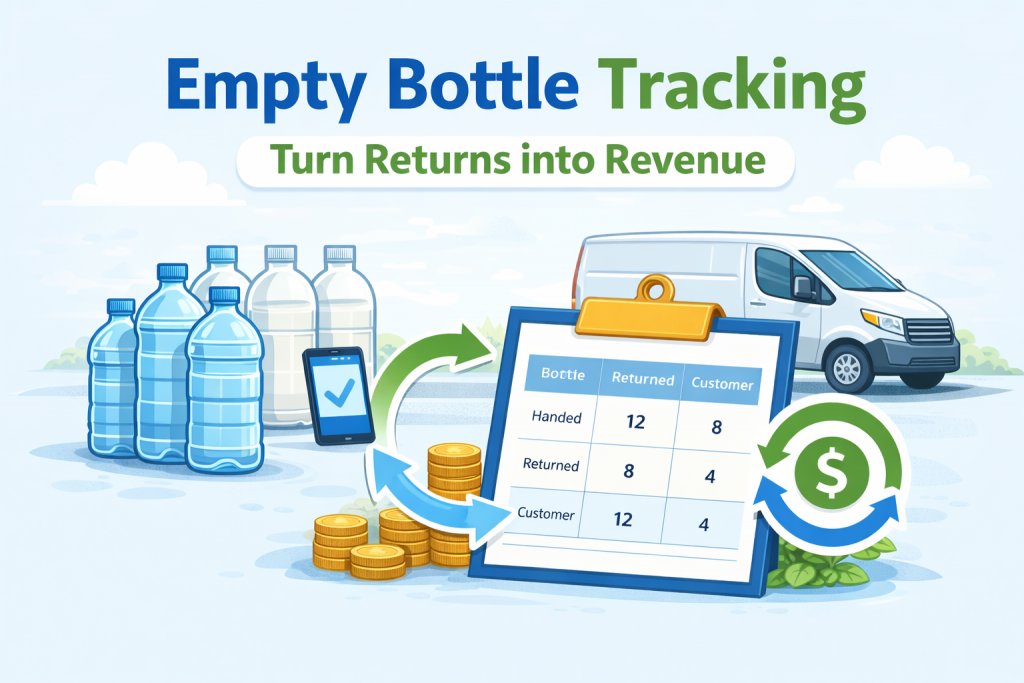
When you’re delivering milk or water in reusable bottles, you’re not just moving liquid — you’re managing assets. Bottles go out full and are supposed to return empty, but in reality, many don’t. Whether it’s forgetful customers, rushed drivers, or missing accountability, unreturned bottles quietly eat into your margins. And if you’re still tracking them with paper slips or spreadsheets, the losses will only scale with your business. That’s where automated empty bottle tracking comes in — helping you recover revenue, reduce disputes, and finally take control of your returnable inventory.
Why Unreturned Bottles Quietly Eat Into Your Profits
Most milk and water delivery businesses assume a few missing bottles here and there is normal. But if you’re sending out hundreds or thousands of bottles per week, even a 5% return gap quickly becomes a financial leak. Multiply that by ₹70–₹100 per bottle, and you’re looking at serious monthly losses.
It’s not just about the cost of replacements. Untracked bottles also create:
- Disputes with customers (“I returned it last time!”)
- Driver friction (miscounts or lack of marking)
- Inventory mismatches at your depot
- Cash flow gaps, especially if bottle deposits are part of your pricing
Every bottle that goes out is a reusable asset. If it doesn’t come back — or you can’t prove it didn’t — you’re effectively giving it away for free. Worse, without a proper system, there’s no way to know where the breakdown happened: driver, customer, or depot.
For growing operations, this adds up. One of the biggest differences between a small delivery setup and a scalable one is how tightly you control your returnable inventory. And that starts with visibility.
Where Traditional Bottle Tracking Breaks (& Why It’s Worse at Scale)
In small delivery operations, tracking empty bottles often starts with paper slips, Excel sheets, or WhatsApp messages between drivers and ops. It feels manageable — until your customer count grows and the system breaks silently.
Here’s where traditional tracking methods typically fail:
Drivers forget to mark returns
Bottles are handed back, but if the return isn’t logged right then, it’s lost. By the time anyone notices, it’s one customer’s word against another’s.
No shared ledger = no accountability
Neither the customer nor the ops team can verify the real-time bottle status. If a delivery agent changes or a customer disputes a deduction, there’s no proof.
Daily delivery adds complexity
Especially in milk delivery, the frequency is high, and bottle handoffs happen every morning. The volume of returnable units moves fast — tracking needs to match that pace.
Reconciliation becomes a full-time job
When you reach 100+ customers or multiple delivery routes, trying to match deliveries vs. returns manually becomes a tedious, error-prone process.
This isn’t just a scaling issue — it’s an operational visibility issue. And visibility is the first step to control.
What an Empty Bottle Tracking System Does (and How It Works Daily)
An empty bottle tracking system turns an informal, error-prone process into a controlled, real-time workflow. Instead of relying on memory or scattered notes, every bottle movement is accounted for, digitally and automatically.
Here’s how it works in a typical milk or water delivery setup:
Assign bottles per delivery
Each order includes a count of full bottles going out and a prompt to collect empties. The expected return count is visible to the driver before they leave.
Drivers mark returns live
Using the delivery app, drivers log how many empty bottles they receive on the spot — no paper, no delay. This update syncs instantly with the customer’s account.
Customer bottle ledger auto-updates
Every bottle handed out or returned adjusts the customer’s ledger. You always know how many bottles a customer owes, and whether a deposit is due or refundable.
Ops teams get real-time visibility
The backend dashboard shows bottle circulation, missing returns, and deposit balances per customer. No end-of-month chaos — you can act before loss compounds.
Billing and refunds stay synced
The system links bottle returns with wallet credits, refunds, or deductions. This keeps payment records accurate and avoids angry calls over disputed bills.
Whether you’re delivering 50 or 5,000 bottles a day, automation gives your team one source of truth — no guesswork, no back-and-forth.
Smart Deposit & Refund Workflows That Keep Customers Happy
Bottle deposits are meant to protect your business — but if handled poorly, they can damage trust, frustrate customers, and cause unnecessary support headaches.
A good tracking system doesn’t just manage bottles — it manages expectations.
Here’s how to get deposits and refunds right:
Set fixed or tiered deposit values per bottle
Most businesses use a flat-rate deposit (₹50–₹100 per bottle), but for B2B or high-volume clients, tiered pricing based on size or quantity may work better.
Credit deposits automatically on return
When a customer returns an empty bottle, and it’s marked in the system, the corresponding deposit is instantly added to their wallet or credited in the next invoice.
Handle damaged bottles with transparent rules
If a bottle is cracked, unusable, or branded and needs replacement, a partial or full deposit deduction can be applied — visible to both the ops team and customer.
Keep it visible in the app
A transparent ledger of bottle counts, deposits collected, and refunds issued builds trust. Customers stop disputing charges when they can see the history themselves.
The goal is not just financial accuracy — it’s reducing friction. Automated deposit workflows turn what used to be a frustrating manual task into a smooth, no-surprises experience for everyone involved.
Reverse Logistics Without Added Delivery Costs
Most delivery businesses think of reverse logistics — like collecting empty bottles — as a cost center. But with the right system, it can be integrated into your existing operations without adding complexity or extra fuel bills.
Here’s how efficient bottle return collection works:
Bundle returns with outbound deliveries
When a driver delivers full bottles, they also collect empties at the same stop. The app prompts them with how many bottles are expected back, reducing the chance of forgetting.
Flag overdue returns and batch pickups
If certain customers haven’t returned bottles over several cycles, the system highlights them for follow-up. These can be added as low-priority stops during regular delivery hours.
Incentivize customer drop-offs (when needed)
For high-density apartments or B2B clients, offering wallet credit for dropping off empties to a nearby hub can reduce your return costs while improving compliance.
Track the bottle flow back to the depot
Bottles collected by drivers are logged at the depot with one tap. You now have a clean chain of custody — from customer to driver to hub — with no gaps.
By embedding bottle returns into your delivery rhythm, you eliminate the need for extra routes, calls, or reconciliation headaches. Reverse logistics doesn’t have to be a second operation — it just needs a smarter one.
How Rekart Powers End-to-End Bottle Tracking
Rekart’s empty bottle tracking isn’t an add-on — it’s baked directly into the delivery workflow for both milk and water businesses. That means your drivers, ops team, and customers stay aligned without extra tools or processes.
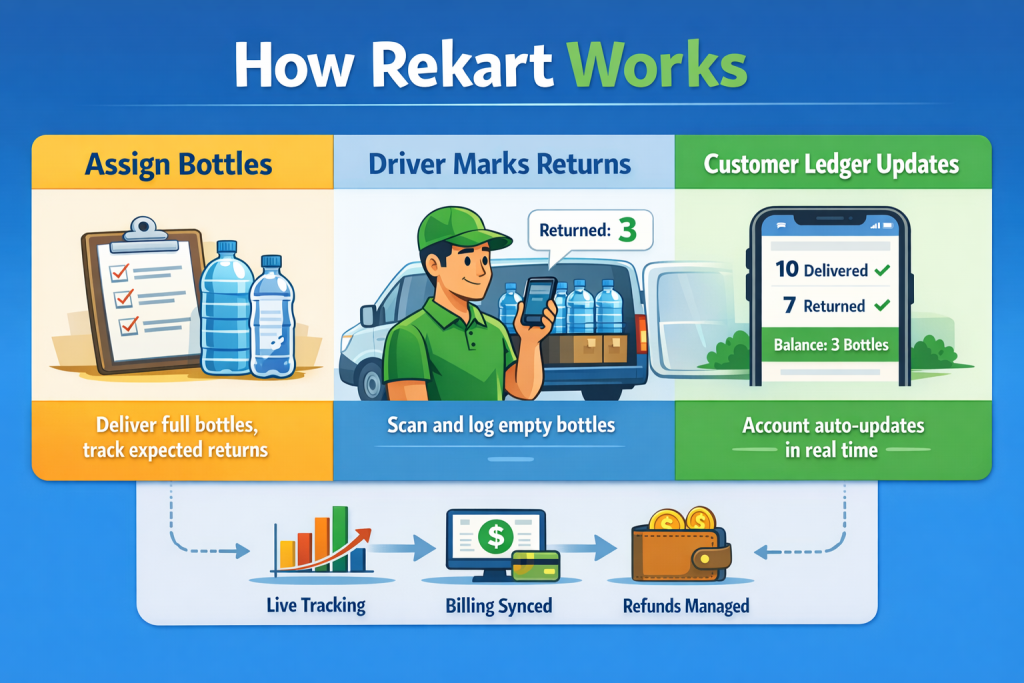
Here’s how it works inside Rekart:
Bottle counts linked to each order
Every delivery includes a record of bottles sent and expected returns. This information is visible to both the driver and the customer.
Driver-side tracking at the doorstep
During delivery, the driver simply taps to mark how many empty bottles were returned. No need for paper slips or end-of-day updates.
Automatic updates to the customer bottle ledger
As soon as bottles are marked returned, the customer’s ledger reflects the new balance. It’s accurate, real-time, and viewable by your support team at any time.
Wallet integration for deposits & refunds
Bottle deposits can be charged and refunded automatically, based on return status. No more manual calculations or guesswork at billing time.
Dashboard for bottle inventory health
Your team gets access to a live report showing how many bottles are in circulation, which customers have overdue returns, and how much value is tied up in unreturned assets.
Whether you’re managing hundreds or thousands of deliveries per day, Rekart makes sure every bottle — and every rupee tied to it — is accounted for.
Bottle Loss ROI: Real-World Savings from Going Digital
Let’s talk numbers. Bottle loss may feel like a small issue, but once you run the math, it’s clear how much it eats into your bottom line.
Example:
- You deliver to 500 customers daily
- Each uses 2 bottles, average deposit per bottle = ₹80
- That’s ₹80,000 worth of bottle assets in circulation
- If just 5% go untracked or unreturned monthly → ₹4,000 lost
- Over a year? That’s nearly ₹50,000 in preventable loss
Now factor in:
- Manual tracking time saved (ops & drivers)
- Fewer customer disputes and refunds
- Cleaner cash flow from real-time deposit tracking
- Higher trust with B2B clients and institutional buyers
Most Rekart clients recover the cost of implementation just from bottle loss savings alone. Add in time saved and smoother delivery ops, and the system pays for itself within weeks.
Conclusion
In milk and water delivery, efficiency isn’t just about how quickly you drop off full bottles — it’s about how reliably you get the empties back.
Every bottle you send out is a reusable asset. Without a system to track what returns and what doesn’t, you’re constantly leaking value — whether through lost deposits, silent mismatches, or billing confusion.
With Rekart’s built-in bottle tracking, you:
- Gain real-time visibility into every return
- Avoid friction between drivers and customers
- Automatically handle deposits, refunds, and reconciliation
- Preserve margins at scale, without adding manual overhead
Whether you’re delivering to 100 homes or managing city-wide B2B routes, bottle tracking isn’t optional — it’s operational hygiene.
👉 Ready to stop guessing and start tracking?
Book a demo with Rekart and see how easy it is to lock down your bottle returns — and your bottom line.
