
Managing Milk Subscriptions at Scale: How Dairy Management Software Handles Daily & Bulk Orders
Introduction
Managing milk subscriptions looks straightforward until volume hits. Ten customers are easy. Fifty require coordination. Five hundred — with a mix of daily, alternate-day and bulk orders — turns scheduling into a moving puzzle. Quantity changes, vacation pauses, hotel demand spikes, and early-morning delivery windows leave very little room for manual planning. Miss one slot, or mis-route a driver once, and the whole rhythm of the day slips.
This is where modern dairy management software makes a tangible difference. Instead of relying on memory, WhatsApp messages and last-minute route reshuffling, subscriptions are automated, batched, sequenced and dispatched with predictable daily logic. The system absorbs the complexity — so operations don’t have to.
Why Scaling Milk Subscriptions Manually Breaks Down
Subscriptions aren’t difficult because milk is hard to deliver — they’re difficult because demand is repetitive but never identical. One customer pauses for two days, another increases quantity without notice, a hotel suddenly needs 50 litres extra for an event, and a gated society expects delivery before 7 AM sharp. None of this fits neatly into a spreadsheet, and even the best dispatcher eventually runs out of mental bandwidth to manage patterns at scale.
Route complexity increases faster than fleet capacity
More customers don’t just mean more stops — it means more branching routes. A single delivery boy can cover 60 homes efficiently when every order is daily. Mix in alternate-day patterns and priority hotel drops, and the same 60 turns into 60 in three fragmented clusters. If routing isn’t system-driven, the fleet grows faster than revenue.
Daily vs alternate-day patterns create an unpredictable load
Day-on/day-off customers double the planning friction. Odd-even patterns, missed weeks, resumed weeks — every subscription behaves differently. An operation that looks stable on Monday can overload on Wednesday and run underutilized on Thursday with no warning. Manual planning can’t see this coming. Software can.
Bulk orders disrupt B2C rhythms instantly
Institutional buyers don’t follow household patterns. They demand early-morning fulfillment, variable volumes and guaranteed allocation. When a hotel increases from 200L to 350L for weekend demand, every B2C route downstream absorbs the shock. Without automated rebalance, the ripple hits timing, freshness and delivery consistency.
Manual scheduling → delayed delivery → churn
Customers don’t complain when milk arrives. They complain when it doesn’t.
One missed drop, one delayed route, one wrong quantity — and retention takes a hit. Subscription businesses bleed silently through churn, not acquisition cost. The difference between retention and churn often comes down to how predictable the system feels to the end user.
The Subscription Challenge in Dairy Operations
Milk is not like other commodities — you don’t deliver it “whenever the truck reaches.” It has a freshness window, customers have fixed routines, and demand fluctuates subtly every day. Subscription-heavy dairies face a different kind of problem curve: predictable orders at scale behave unpredictably without structure. The challenge is not demand — it’s timing, volume variance, last-minute change requests, and how fast these variations break a manual planning system.
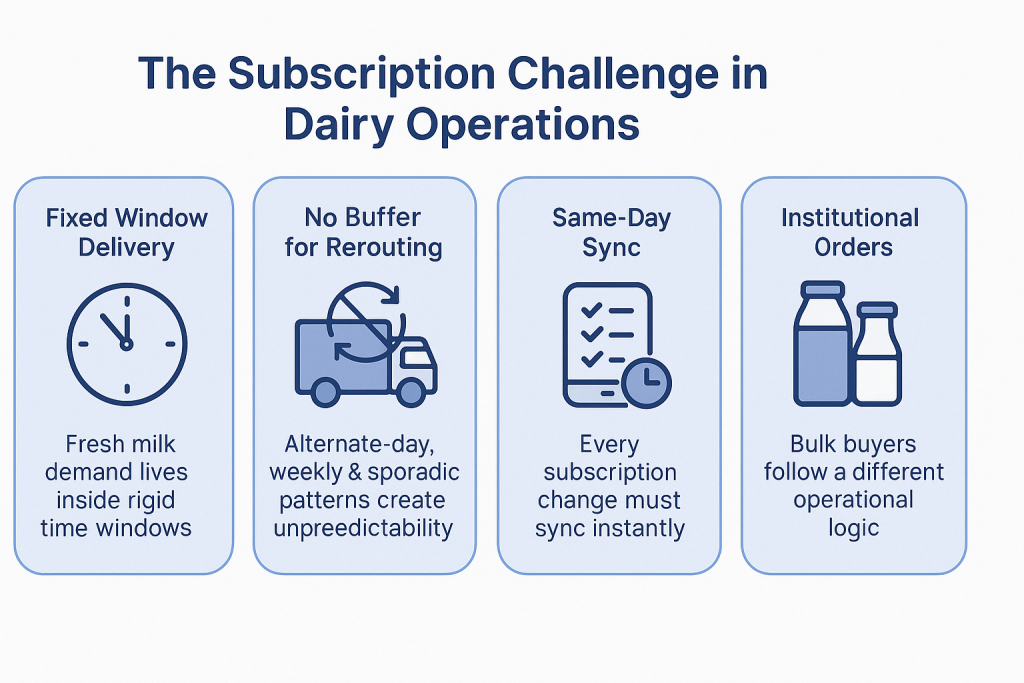
Fresh milk demand lives inside rigid time windows
If a household expects milk at 6:30 AM, 7:15 is already late.
Unlike FMCG or bottled water, dairy is unforgiving — the window to get routing right is narrow. A five-minute delay to one route can cascade across the city, and by the time the fleet reaches the last drops, customer satisfaction is already damaged.
Alternate-day, weekly & sporadic patterns create unpredictability
Subscriptions aren’t binary. Some customers pause on Sundays, some take double the quantity only on weekends, some need half a litre on weekdays and a full litre otherwise. These micro-fluctuations stack up. Without automation, dispatchers lose track — not because they’re careless, but because humans are not designed to remember 500+ unique delivery rhythms.
Bulk buyers follow a different operational logic
Hotels, cafés, supermarkets, and hostels — they place large recurring orders, but not always in the same volume. They need weekend boosts, event-day surges, and sometimes emergency refills. Bulk demand doesn’t just scale volume — it disrupts route geometry. Drop 300 litres early in the morning, and suddenly the fleet must re-balance capacity for everything else.
Every subscription change must sync instantly
A single household increasing from 1L to 1.5L shouldn’t require a call, ledger update, planner revision, and manually notifying the driver. The system should absorb this change automatically — frequency, quantity, billing, and route assignment should update in real-time, not tomorrow.
How Dairy Management Software Automates Subscription Planning
At scale, success isn’t about taking more orders — it’s about handling variations without friction. A dairy may serve 800 households, 14 retail counters and 6 hotel contracts in the same morning. Each has a different frequency, volume and cut-off window. Dairy management software absorbs this complexity by converting subscription behaviour into automated delivery logic — recurring schedules, quantity adjustments, batching, and dispatching happen without the daily chaos.
Auto-repeat scheduling for daily, alternate-day & custom plans
Customers can pick frequencies — daily, alternate-day, Mon-Wed-Fri, weekends only, first-of-month bulk — and the system repeats it automatically.
No manual reminders. No paper slips. No “Did we deliver today?” calls.
Subscriptions become rules, not memory.
Smart batching based on locality & delivery density
The software groups orders within the same neighbourhood, so routes don’t zig-zag across the city.
30 drops in one sector are completed before moving to the next — predictable, fuel-efficient, cleaner.
More density = less distance = better margins.
Auto-quantity scaling for hotels, cafés & retail counters
If a commercial buyer’s demand jumps from 60L/day to 120L for a week, the system adjusts capacity allocation automatically — without disturbing B2C subscriptions.
The fleet doesn’t guess capacity; it operates on data.
Pause, resume & one-click changes without rerouting chaos
Vacations, overstock days, temporary skips — customers pause plans themselves.
No dispatcher intervention required.
Routes auto-recalculate. Quantities sync. Billing remains accurate.
This single feature prevents hundreds of manual corrections each month.
Daily, Alternate-Day & Weekly Plans — Real Use-Cases
The true test of a subscription system isn’t how it works in a demo — it’s how it behaves on a Tuesday when 400 daily orders, 160 alternate-day orders, seven paused subscriptions, and two hotels needing extra supply collide in the same hour. Below are practical operational cases that dairies face every single day, and how dairy management software absorbs variation instead of forcing people to manage it manually.
A residential society with 70 recurring drops — all before 7:30 AM
The building has a mix of 500ml, 1L, and 1.5L plans. Most are daily, but 14 are Mon-Wed-Fri only.
Without automation:
- Driver must remember who receives what
- Any quantity change requires manual update
- One missed flat → complaint → churn risk
With software:
- The route auto-loads the exact homes for that day
- Quantities adjust even if changed an hour earlier
- Reports confirm completion automatically
No mental math. No guesswork. No chaos.
A family that only needs milk every alternate day
Odd-even logic breaks humans, not systems.
Software simply checks the date, generates the order if it’s an “active day,” and skips if not.
No one has to remember — and no one forgets.
A hotel increases its bulk by 60 litres before the weekend
Commercial demand spikes aren’t uncommon.
The system reallocates route capacity, adjusts loading, and reserves stock early — without affecting B2C delivery timing.
Data prevents ripple failure.
Subscription changes handled without rerouting hell
A user increases quantity at 10 PM, pauses at 11 PM, resumes two days later with a different frequency — all normal behaviour.
In a manual setup → confusion.
In software → just another input.
Routes adapt, billing updates, and delivery stays accurate.
Bulk Commercial Orders — The Real Stress Test
Households create volume. Commercial clients create volatility.
A dairy can comfortably serve 600 homes with predictable subscription logic, but a single hotel requesting +120 litres for a wedding instantly reshapes the entire route plan. Retail counters place weekly refill orders but may demand mid-week top-ups. Supermarkets expect consistent quality and priority unloading. Bulk orders don’t break dairies because they are large — they break dairies because they are variable.
This is where dairy management software becomes not just helpful, but essential. It allocates stock, balances vehicle capacity, preserves B2C commitments, and ensures commercial drops don’t cascade into late residential deliveries.
30L, 300L or 1,000L — capacity planning can’t be manual
En-route planning works until demand spikes. A 3× increase from a single commercial client can push fleet capacity off balance, resulting in:
- Underfilled residential routes
- Need for second runs
- Fuel + time + manpower overuse
Software prevents this by forecasting load per route — not per truck.
Priority handling without punishing B2C delivery
Commercial clients are high value, but B2C quantity is your volume engine.
Balancing both is the art.
When bulk orders are mapped into the system:
✔ Allocation blocks stock in advance
✔ B2C routes remain unaffected
✔ Loads are distributed across vehicles intelligently
Capacity is not guessed — it’s calculated.
Bulk variability becomes a rule, not a disruption
A hotel increasing quantity for 3 days should not require five phone calls and route reshuffling.
Software treats this as:
Change in variable → Update quantity → Rebalance load → Auto-sync dispatch
No chaos. No rework. No panic at 5:30 AM.
The Result — Higher Subscription Retention & Lower Operational Waste
When subscription logic is automated, the entire operation becomes calmer and more predictable. Drivers stop relying on memory, dispatchers stop firefighting, and customers stop calling to confirm delivery. Fresh milk arrives when it should, in the right quantity, with no confusion — and retention rises naturally. Long-term revenue in dairy does not come from acquiring new customers every month; it comes from retaining the ones you already serve.
No daily reminder calls — orders auto-generate
Customers shouldn’t have to confirm milk every morning. Software remembers frequency, quantities, pauses, and restarts with precision.
No follow-ups → fewer errors → higher satisfaction.
No rescheduling chaos when customers change patterns
Vacation pause? One-click.
Quantity change? Real-time sync.
Alt-day shift? Auto-adjust without human input.
The system adapts instantly — drivers don’t.
Drivers no longer carry the ops load on their shoulders
When routing is manual, the entire operation depends on a few people knowing the map in their head.
When routing is automated, knowledge is stored in the system — not in people.
Retention of staff and customers both become easier.
Efficiency compounds daily — small gains become big savings
Even a 5% improvement per route, per day, compounds over a month.
Less backtracking → less fuel → less time → more completed routes without extra manpower.
Profit grows not from volume — but from efficiency.
Final Thoughts — Subscription Drives Revenue. Software Drives Scale.
A dairy doesn’t scale because it sells more milk — it scales because it delivers more milk without increasing chaos. Subscriptions are predictable, but human memory and manual planning aren’t built for 800 frequencies, 12 route clusters, and three hotels asking for urgent top-ups. When the system plans the day instead of people, operations stabilize. Milk arrives fresh, customers stay longer, churn drops quietly, and cost-per-delivery decreases over time. If you’d like to evaluate subscription automation for your dairy operation, you can book a walkthrough.
Dairy management software doesn’t replace dispatchers — it gives them superpowers.
The business becomes scalable not because demand increases, but because complexity no longer breaks it.
