
Why Fragmented Data Hurts Dairy Operations & How a Dairy Management System Fixes It
Introduction
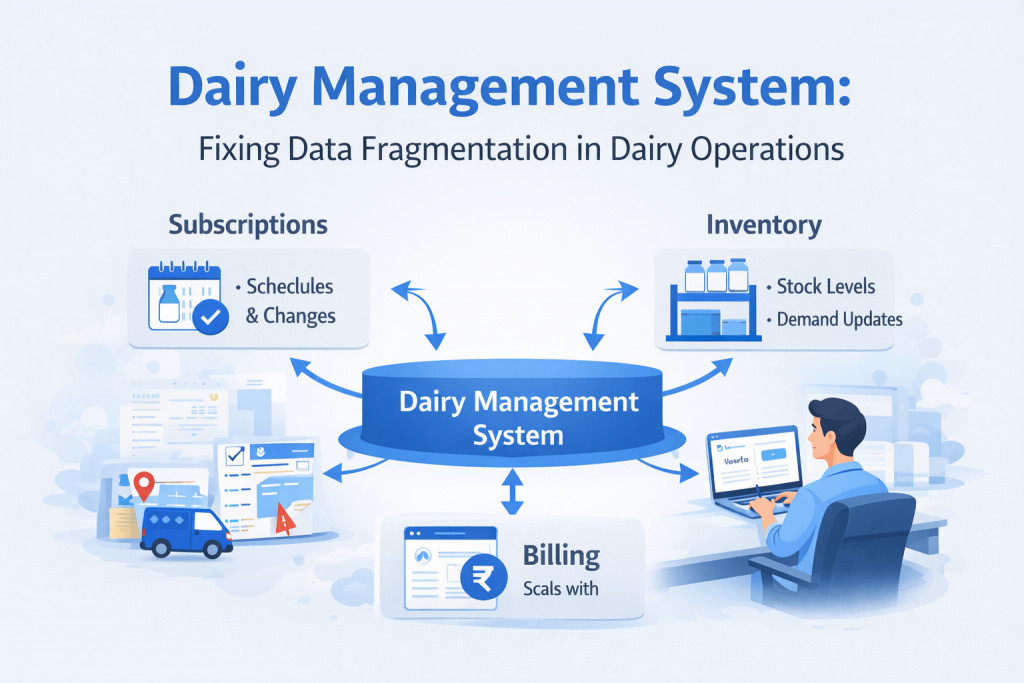
Dairy operations break down not because of demand, but because critical data is scattered across spreadsheets, apps, and manual logs. When subscriptions, inventory, deliveries, and billing live in different places, teams lose visibility, and decisions become reactive. This fragmentation leads to stock mismatches, delivery errors, billing disputes, and wasted effort. A dairy management system fixes this by centralizing operational data into one system, allowing dairies to plan, execute, and respond with clarity instead of guesswork.
What Fragmented Data Looks Like in a Real Dairy Operation
In most dairies, different teams rely on different sources of information. Subscription details are tracked in spreadsheets, delivery routes live in drivers’ notebooks, inventory is estimated at dispatch, and billing is reconciled after the fact. None of these systems talks to the other.
The result is a constant mismatch. Inventory doesn’t reflect actual demand. Routes are planned without visibility into last-minute changes. Billing doesn’t match what was delivered. When an issue surfaces, teams spend time cross-checking data instead of fixing the root cause. Fragmentation turns simple decisions into slow, error-prone processes.
The Hidden Costs of Fragmented Data in Dairy Operations
Fragmented data creates costs that don’t always show up immediately. Overstocking happens because demand isn’t visible in one place. Shortages occur because last-minute subscription changes don’t reach inventory planning. Deliveries get delayed when route plans don’t reflect real orders. Billing errors creep in when delivered quantities don’t match records.
Over time, these issues compound. Fuel costs rise due to inefficient routes. Customer trust erodes because of repeated mistakes. Teams spend hours reconciling data instead of improving operations. What looks like a “data problem” quietly turns into a margin and retention problem.
How a Dairy Management System Centralizes Data
A dairy management system works by removing data silos and creating a single operational backbone. Instead of different teams relying on separate tools, all critical workflows feed into one system.
What gets centralized in practice
Customer & subscription data
- Daily, alternate-day, weekly schedules
- Pauses, quantity changes, and address updates
Inventory & demand data
- Planned demand based on confirmed subscriptions
- Adjustments from last-minute changes
Delivery & route data
- Route assignments linked to actual orders
- Driver-level execution data
Billing & payment records
- Wallet balances, invoices, adjustments
- Delivered vs billed quantity reconciliation
Why does this matter operationally?
- A quantity change updates inventory planning automatically
- A pause reflects immediately in route load calculations
- Billing pulls from actual delivery data, not estimates
How Centralized Data Improves Daily Decision Making
Fragmented systems force managers to make decisions with incomplete information. A centralized dairy management system changes the quality of daily decisions across the board.
Inventory & procurement decisions
- Procurement aligns with actual subscription demand
- Overstocking reduces because demand is predictable
- Shortages drop as changes are reflected in real time
Delivery & route planning decisions
- Routes are planned using confirmed orders
- Load distribution reflects real quantities
- Exceptions (skips, increases) are handled proactively
Billing & finance decisions
- Delivered quantities match invoices
- Disputes reduce due to clear delivery records
- Cash flow becomes more predictable
Operational prioritization
- Teams know what needs attention first
- Managers spot bottlenecks early
- Decisions shift from reactive to preventive
The Result: Better Control, Lower Waste, and Confident Scaling
When data is centralized, dairy operations become predictable instead of reactive. Inventory matches demand more closely, delivery plans run smoothly, and billing disputes are reduced significantly. Teams spend less time reconciling errors and more time improving efficiency.
Most importantly, growth no longer introduces chaos. As routes, customers, and subscriptions increase, the system absorbs complexity instead of amplifying it. A dairy management system gives dairies the control they need to scale with confidence, without sacrificing accuracy, margins, or customer trust.
