
How to Start a Milk Delivery Business: A Complete Step-by-Step Guide for New and Existing Operators
Introduction
Milk delivery looks deceptively simple. Customers are there. Demand is daily. Revenue is recurring. On paper, it’s one of the most reliable local businesses you can run.
But talk to anyone who’s actually tried to scale it past 50 customers, and you’ll hear the same story: missed deliveries, billing disputes, bottle losses, drivers going off-route, and a WhatsApp inbox that never stops buzzing.
The business model is solid. The execution is where it gets hard.
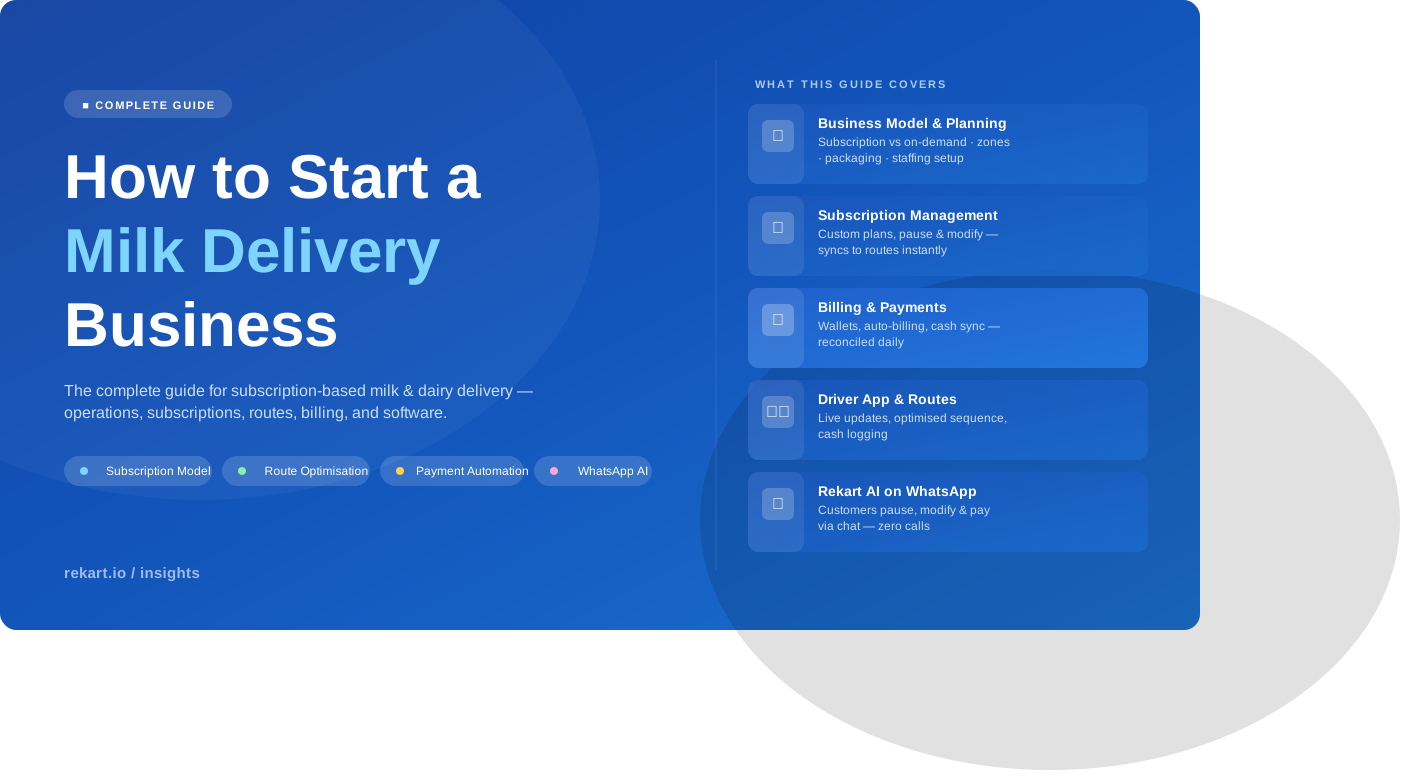
This guide walks you through every step of how to start a milk delivery business — from choosing your model and sourcing to building your customer base, setting up subscriptions, and running daily operations without burning out. Whether you’re starting from scratch or adding a delivery arm to an existing dairy, this is a practical breakdown of what it actually takes.
Is a Milk Delivery Business Worth Starting?
Yes — but only if you build it on a subscription model and get your operations right early.
Here’s what makes milk delivery structurally attractive:
- Daily demand. Milk is a daily staple — not a discretionary purchase. Your customers need it every day, which means consistent, predictable order volume.
- Recurring revenue. Subscription-based milk delivery means you’re not re-acquiring customers every day. Once they’re signed up, revenue is locked in until they cancel — and with good service, most don’t.
- High retention potential. Customers who are happy with their delivery don’t switch. Switching a daily milk supplier requires effort — that inertia works in your favour.
- Low customer acquisition cost at scale. Happy customers refer neighbours. In housing societies and apartment complexes, one satisfied customer can become ten.
That said, milk delivery is operationally demanding. Deliveries happen early in the morning. Customers are particular about timing. The margin on milk itself is thin, so operational efficiency is what determines profitability.
The businesses that make it work are the ones that systematise early routes, billing, subscriptions, and customer communication. The ones that don’t tend to burn out somewhere between 40 and 100 customers.
Step 1: Decide Your Business Model
Source-Based vs. Distribution-Based
There are two fundamental models:
- Own dairy or farm → D2C delivery: You produce the milk (or curd, paneer, ghee) and deliver directly to end customers. Higher margin, stronger brand, more operational complexity.
- Third-party sourcing → resell and deliver: You source from a dairy or cooperative and build a local delivery business around it. Lower upfront investment, margin depends on sourcing cost.
- Franchise/aggregator model: You operate under a larger brand’s network. Structured but limited by franchise terms.
What Products Will You Deliver?
Start focused. Milk is the anchor product — daily demand, easy subscription. Once operations are stable, you can layer in:
- Curd, paneer, ghee, butter
- Flavoured milk or health variants
- Bundled dairy subscription packs
Adding products increases complexity. Each SKU adds to driver load, inventory management, and billing variation. Don’t add SKUs before your core delivery operation is running clean.
Why the Subscription Model Is Non-Negotiable
Milk delivery only makes financial sense as a subscription business. On-demand ordering makes the economics nearly impossible — you can’t optimise routes or predict demand when orders are random.
Subscription plans define what gets delivered, when, and how much. Common structures:
- Daily delivery (same quantity every day)
- Alternate-day delivery
- Custom frequency (e.g., weekdays only)
- Variable quantity (e.g., 500ml Mon–Fri, 1L on weekends)
The subscription model is also what enables pause management — customers who go on holiday pause instead of cancel. That single feature has a significant impact on churn.
| 💡 Key Insight Subscription businesses retain customers significantly longer than transactional models. In daily delivery, the ability to pause — rather than cancel — is one of the highest-impact retention levers you have. |
Step 2: Plan Your Operations Before You Launch
Define Your Delivery Zones
The most common mistake new milk delivery businesses make is starting too wide. One neighbourhood, done well, is better than five neighbourhoods done badly.
Start with a single pincode or locality. Get your routes tight, your drivers familiar with the area, and your customers happy before expanding. Every new zone adds route complexity, potential for missed deliveries, and management overhead.
Practical zone planning factors:
- Distance from your storage/dispatch point
- Delivery density — more customers per km = better fuel economics
- Terrain and traffic patterns at 5–7 am
Plan Your Delivery Slots
Most milk delivery businesses operate in a single morning slot (5 am–8 am). Some add an evening slot for curd, paneer, or fresh products.
Important: multi-slot delivery sounds simple, but adds significant complexity — different products, different quantities, different billing. If you’re launching, start with one slot. Add the second once the first is running smoothly.
Slot timing also affects driver scheduling. Early morning deliveries mean your driver’s day starts at 4:30–5 am. Build your staffing model around that reality.
Packaging and Bottle Management
Your packaging choice has operational consequences beyond just cost:
- Pouches: Low cost, no returns, but customer waste and perceived quality can vary
- Plastic bottles: Reusable, better experience, but require a return system
- Glass bottles: Premium positioning, but fragile, heavier, and expensive to replace
If you’re using reusable bottles, you need a bottle return tracking system from day one. Untracked bottle losses quietly erode your margins — at scale, it becomes a serious cost. See our guide on empty bottle tracking for delivery businesses for how to handle this systematically.
Delivery Staff — What You Actually Need
A rough benchmark: one delivery driver can handle 80–120 daily stops, depending on zone density and delivery slot window.
What your driver needs to know before day one:
- Their exact route — sequence of stops, not just a list of addresses
- What to deliver at each stop (quantity, product, special instructions)
- How to collect cash where applicable
- How to handle missed deliveries (leave at door, call customer, report back)
- How to log proof of delivery
If you’re managing driver briefings manually, this works at small scale. Beyond 2–3 drivers, you need a system that gives each driver a digital route sheet automatically.
Step 3: Build Your Customer Base
Start With Your Network
Your first 10–20 customers should come from people who already trust you. Friends, family, colleagues, people in your building. Offer a free trial week — low commitment, and it lets them experience the service before subscribing.
Don’t try to acquire 100 customers in month one. Acquire 20, serve them exceptionally well, and let word of mouth do the rest.
Go Hyperlocal First
Milk delivery is a hyperlocal business. Your marketing should be too.
- Post in WhatsApp groups for your target neighbourhoods and housing societies
- Put up flyers on notice boards in apartment complexes
- Talk to society admins — a society-wide deal can bring 20+ customers at once
- Set up a Google Business Profile for local search visibility — it’s free and genuinely drives enquiries
What Makes Customers Stay
Acquiring a milk delivery customer is easy. Keeping them is about three things:
- Consistency: Same time, every day. Customers plan their mornings around your delivery. Late delivery — even once — erodes trust fast.
- Flexibility: The ability to pause a delivery, change quantity, or skip a day without calling anyone is the #1 retention factor in subscription delivery. Customers who can self-manage never churn from inconvenience.
- Transparency: Customers want to know their balance, their delivery history, and their upcoming orders. An app or WhatsApp channel that provides this eliminates 80% of support queries.
For a deeper look at how subscription management software affects dairy customer retention, see: Managing Milk Subscriptions at Scale.
Step 4: Set Up Your Subscription and Billing System
This is where most milk delivery businesses break down — not because of the product or the service, but because the back-end can’t keep up.
Spreadsheets and WhatsApp work for 20 customers. At 50, the cracks start showing. At 100, it becomes a full-time job just managing the admin.
Here’s what you need to manage at scale:
- Custom subscription plans per customer — quantity, frequency, product type, start date
- Pauses, modifications, and skips — handled without manual intervention
- Billing cycles — daily wallet deduction, weekly invoice, monthly billing, or custom
- Payment collection — cash, UPI, online wallets, prepaid top-ups
- Outstanding balance tracking — automated alerts when a customer’s wallet runs low
- Invoice history — visible to customer, accessible without a support call
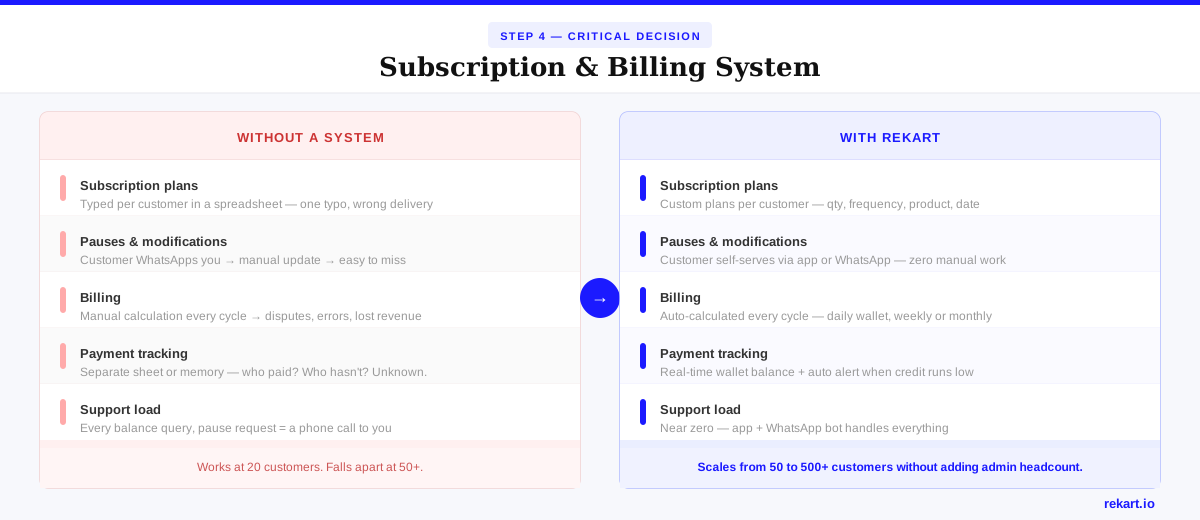
This is exactly what platforms like Rekart are built for — a subscription engine that handles custom plans, auto-billing, pause management, and payment tracking without manual intervention. It’s the operational backbone that lets you grow from 50 to 500 customers without adding admin headcount.
Manual vs. software — what the difference actually looks like in day-to-day operations:
| Task | Manual (Spreadsheet/WhatsApp) | With Rekart |
| Subscription plans | Typed per customer, error-prone | Custom plans created in minutes |
| Pauses & modifications | WhatsApp message → manual update | Customer self-serves via app or WhatsApp |
| Billing | Manual calculation, frequent disputes | Auto-calculated, cycle-based billing |
| Payment tracking | Separate spreadsheet or memory | Real-time wallet + outstanding alerts |
| Route assignment | Driver calls/messages at the end of day | Auto-assigned by zone and driver |
| Delivery confirmation | Driver calls/messages at the end of the day | Real-time POD with photo upload |
| Bottle tracking | Physical tally or rough memory | System tracks returns per delivery |
| Customer support calls | High — customers call for every change | Low — app + WhatsApp bot handles it |
For more on how subscription billing works in milk delivery: Dairy Payment Management — The Complete Guide and Automated Billing for Milk & Water Delivery.
Step 5: Set Up Your Delivery Operations
Route Planning — Don’t Leave This to Guesswork
Manual route planning — a list of addresses sorted by memory or rough geography — works until it doesn’t. Drivers take inefficient paths, run late, miss stops, and burn through fuel. It also means you, the business owner, are spending an hour every night planning the next day’s routes.
Route optimisation assigns stops in the most efficient sequence by zone, pincode, or geo-fencing. It accounts for multiple drivers, multiple delivery slots, and ensures each driver’s load is balanced.
The same principles apply whether you’re delivering milk or water. See: How Route Optimisation Reduces Fuel Waste for Delivery Businesses.
The Driver App — What Your Field Team Actually Needs
Your drivers don’t need a complicated system. They need three things:
- A clear route sheet — who to deliver to, in what order, with what quantity
- A way to log delivery confirmation and collect cash
- Something that works even when the internet is patchy
Rekart’s Driver App handles all of this — auto-assigned routes loaded each morning, offline delivery sheets, real-time sync of cash collection and proof of delivery back to your dashboard once the driver is back online. No paperwork, no end-of-day calls.
Real-Time Delivery Visibility
As a business owner, you shouldn’t be waiting for end-of-day reports to know if deliveries are on track. You need:
- Live delivery status — which stops are done, which are pending, which were missed
- Cash reconciliation — how much was collected vs. expected
- Missed delivery alerts — so you can act before the customer complains
Rekart’s admin dashboard gives you all of this in real time — delivery confirmations, driver locations, outstanding payments, and daily summary reports, without chasing your drivers for updates.
Step 6: Give Customers a Self-Service Experience
The biggest support load in a milk delivery business isn’t complex problems. It’s simple, repetitive requests:
- “Please pause my delivery tomorrow.”
- “Change my order from 1L to 500ml from Monday.”
- “What’s my current balance?”
- “I didn’t receive my delivery this morning.”
If every one of these comes through as a WhatsApp message or phone call, you have a customer service problem that scales proportionally with your growth. At 200 customers, this is a full-time job.
The solution is self-service — putting the controls in the customer’s hands.
The Customer App
A branded customer app lets customers manage their own subscriptions — pause, modify, skip, top up their wallet, view invoices, and track today’s delivery. No calls, no messages.
Rekart’s customer app is fully white-labelled — published under your brand name on the App Store and Play Store, so customers experience it as your app, not a third-party tool. This matters for brand trust, especially for D2C dairy brands building a direct customer relationship.
WhatsApp as a Self-Service Channel
Not every customer downloads an app. Many — especially in markets like India, the Middle East, and Southeast Asia — prefer WhatsApp for everything.
This is where Rekart AI becomes a real operational advantage. Customers message in natural language — “pause my delivery tomorrow” or “change to 1 litre from next week” — and the WhatsApp bot handles it, updating the order system automatically without any human involvement.
This is not a feature any of Rekart’s competitors currently offer. For businesses serving customers who prefer chat over apps, it dramatically reduces support load while improving the customer experience.
| 🤖 Rekart AI — WhatsApp Self-Service Customers send a WhatsApp message. Rekart AI understands the request, updates the subscription or delivery in the system, and confirms back — all without a human in the loop. Pause, modify, skip, check balance — all via chat. |
Step 7: Track, Measure, and Scale
Once your delivery operation is running, the focus shifts to what the numbers are telling you.
The metrics that matter most for a milk delivery business:
- Active subscriptions vs. churned: Your net subscriber growth tells you whether you’re building or losing momentum
- Revenue per route: Identifies which routes are profitable and which are burning more than they’re earning
- Delivery success rate: What percentage of deliveries are completed on the first attempt — a key quality metric
- Outstanding payments: Customers with low or negative wallet balances — revenue at risk
- Bottle return rate: For reusable packaging, this directly affects your asset cost
Rekart’s dashboard gives you all of this in one place — delivery reports, payment analytics, subscription trend data, and route performance, updated daily.
When you’re ready to expand to a new zone or route, look for these signals:
- Your existing routes are running at an 85%+ delivery success rate consistently
- You have a waitlist or organic enquiries from the target area
- Your current billing and subscription management isn’t creating manual work
For a practical look at what breaks when you try to scale delivery operations too fast, see: Why Delivery Workflows Break After 50 Orders.
Common Mistakes New Milk Delivery Businesses Make
These show up consistently — and most of them are avoidable:
| Mistake | Why It Hurts |
| Expanding zones before ops are stable | Using WhatsApp/spreadsheets for past 30 customers |
| Using WhatsApp/spreadsheets for past 30 customers | Manual errors compound — wrong orders, missed pauses, billing disputes |
| Not offering pause flexibility | Customers cancel instead of pausing — the #1 churn trigger in milk delivery |
| Manual billing | Drivers get confused, deliveries are missed, and customers churn fast |
| No bottle return system | Losses add up quietly — at scale, untracked bottle loss kills margins |
| No customer app or self-service | Every query becomes a support call — unsustainable past 100 customers |
| Skipping route optimization | Fuel costs and delivery times balloon; driver burnout sets in early |
How Much Does It Cost to Start a Milk Delivery Business?
The honest answer: it depends heavily on your market, scale, and whether you already own assets like a vehicle. But here’s a practical framework for thinking about startup costs:
| Cost Area | What It Covers | Budget Level |
| Bike, van, or cycle, depending on scale | Initial stock from dairy farm or wholesaler | Varies widely by volume and region |
| Packaging | Bottles, pouches, insulated bags, crates | Low–Medium |
| Delivery vehicle(s) | Bike, van, or cycle depending on scale | Medium–High (existing asset helps) |
| Delivery staff | 1 driver per 80–120 deliveries/day (approx.) | Ongoing operational cost |
| Customer acquisition | Flyers, WhatsApp, Google Business, word of mouth | Low at launch |
| Delivery management software | Subscription + route + billing + apps | Low — fraction of one staff cost |
The standout point in that table: software is consistently the lowest-cost, highest-leverage investment. A delivery management platform like Rekart costs a fraction of what it would cost to hire even one additional operations or admin person — and it replaces the work of several.
Rekart offers a free 7-day trial — no credit card required — so you can see exactly how it fits your setup before committing.
| 📅 Want to see Rekart in action? Book a free demo and see how leading dairy delivery businesses manage subscriptions, routes, billing, and customer self-service from a single platform. No sales pressure — just a live walkthrough of the product. |
Conclusion
The milk delivery business model is proven. Demand is there. The subscription structure works. There are businesses around the world running profitable, well-organised milk delivery operations with 200, 500, even 1,000+ customers.
The ones that thrive didn’t get there by working harder. They got there by setting up the right systems early — subscriptions, routes, billing, customer self-service — so that growth doesn’t require proportionally more effort.
The ones that burn out made the same set of avoidable mistakes: starting too wide, tracking too manually, and waiting too long to bring in the right tools.
If you’re serious about building a milk delivery business that actually scales, Rekart is the platform used by leading dairy delivery brands across the globe.
